
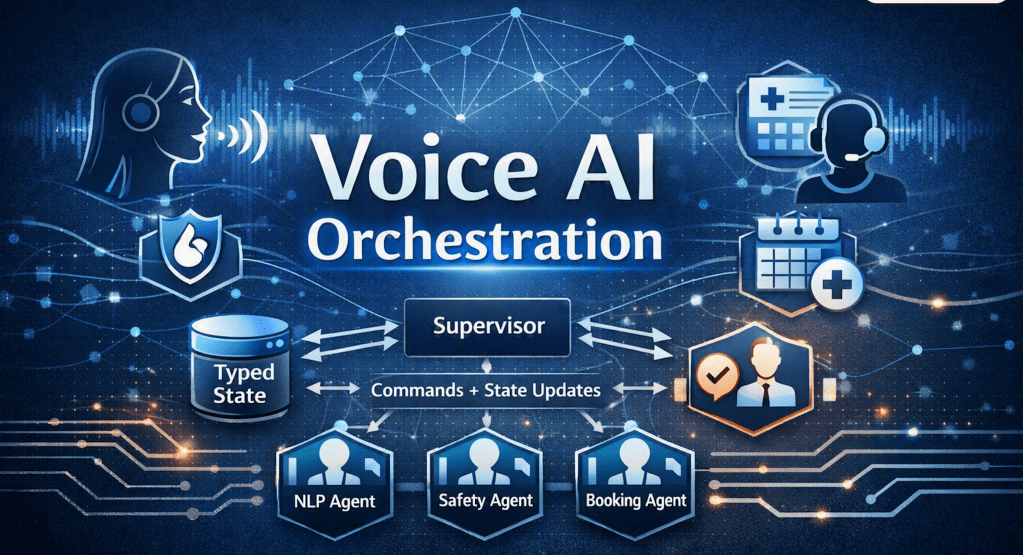
Voice AI has moved far beyond simple chatbots. Modern systems must manage multiple conversational flows, enforce safety, authenticate users, handle interruptions, and execute multi‑step workflows under strict latency and adversarial conditions. Prompting alone cannot deliver this reliability.
At a production scale, Voice AI requires multi‑agent graph engineering: deterministic supervisors, typed state transitions, scoped specialist agents, and layered guardrails. This is the foundation of multi‑agent orchestration—the architecture behind every enterprise‑grade voice system.
Although this article focuses on Voice AI, the principles of deterministic multi-agent orchestration apply equally to other conversational AI systems that rely on structured workflows, safety ordering, and state-driven control. This article explains the core pillars of multi-agent orchestration, outlines the key best practices I have found most critical in the VoiceAI system—what each principle is, why it matters, and what breaks without it—and shows how these principles come together in a supervisor‑driven healthcare voice agent that handles safety, authentication, booking flows, and human escalation with deterministic control.
The Pillars of Multi‑Agent Orchestration
- Supervisor — Deterministic Routing
The supervisor decides which agent runs next by reading typed state and applying priority‑ordered routing rules. This ensures predictable behaviour, strict ordering of safety and authentication checks, and stable workflows across turns.
- Typed State — Structured Memory
Typed state is the system’s single source of truth. It stores canonical facts such as intent, authentication status, safety flags, workflow progress, and tool results. Structured state prevents hallucinations, enforces domain boundaries, and enables auditability and resumability.
- Specialist Agents — Scoped Expertise
Each agent handles one domain: intent classification, authentication, symptom triage, medication information, appointment booking, or human escalation. Agents update the typed state and return control to the supervisor, keeping reasoning scoped and predictable.
Together, these pillars replace the fragility of monolithic prompting with a reliable, testable, and auditable system.
Key Takeaways for Voice AI Multi‑Agent Architecture
(Each practice includes what it is, why it matters, and what breaks if you skip it.)
1. Deterministic Supervisor Routing
What: A code‑based supervisor evaluates typed state to compute the next agent.
Why: Guarantees predictable execution and eliminates routing ambiguity.
Without this: LLM‑based routing adds 300–500 ms latency and causes random misroutes under noise.
2. Typed State as the Single Source of Truth
What: A strongly typed schema stores all context, variables, and flags.
Why: Prevents hallucinations and keeps agent memory clean.
Without this: The model invents facts, repeats steps, or drifts away from workflows.
3. Strict Safety & Prompt Injection Guardrails
What: High‑speed classifiers (small, lightweight ML models) run in parallel to screen for toxicity, emergencies, and jailbreaks.
Why: Safety overrides must fire immediately.
Without this: Harmful inputs slip through or delay emergency triage.
4. Structural Authentication & Authorization
What: An identity‑verification flow or external provider updates authorization flags in the state.
Why: Sensitive operations require verified identity.
Without this: The model “guesses” identity from dialogue, causing compliance violations.
5. Interrupt & Voice UX Handling
What: Detect interruptions and silence at the telephony layer, then use typed state to pause/resume workflows without corrupting turn‑taking. Enforce strict <800 ms latency budgets to maintain natural conversational flow.
Why: Voice interactions are non‑linear; users interrupt frequently, and the system must react instantly while keeping workflows consistent.
Without this: The agent talks over the user, STT misfires, silence is misinterpreted as intent, latency causes dead air, and workflows corrupt or skip steps.
6. Workflow Determinism
What: Agentic subgraphs run multi‑step workflows in strict, state‑driven sequences.
Why: Healthcare and financial flows require ordered steps.
Without this: The model skips verification, loops endlessly, or jumps ahead.
7. Tool Call Correctness
What: Tools receive arguments from typed state, not raw text.
Why: Ensures correctness and idempotency.
Without this: Tools receive malformed inputs, corrupting records or triggering unsafe actions.
8. Checkpointing for Resumability
What: Persist state after every node.
Why: Telephony drops are common.
Without this: Users must restart entire flows after disconnects.
9. Observability & Metrics
What: Log latency, guardrail triggers, routing decisions, and tool success rates.
Why: Voice AI debugging requires granular visibility.
Without this: Failures become invisible and impossible to diagnose.
10. Clean Escape Hatches
What: First‑class routes to human specialists.
Why: Some scenarios must be handled by humans.
Without this: Users get stuck in loops or receive inappropriate automated responses.
11. Scoped Agent Design
What: Design each agent with strict domain boundaries, minimal prompts, and well‑defined input/output schemas.
Why: Ensures predictable reasoning, prevents cross‑domain leakage, and guarantees clean, structured updates to typed state.
Without this: Prompts bloat, agents bleed into each other’s domains, outputs become inconsistent, and typed state gets corrupted—making debugging extremely difficult.
12. Event‑Sourcing
What: Persist every state mutation as an immutable event.
Why: Enables deep auditing and replayability.
Without this: Root‑cause analysis becomes harder, though core functionality still works.
13. Evaluation & Testing Framework
What: Run turn‑level, workflow‑level, and safety‑level evaluations across the entire graph.
Why: Voice AI breaks silently; continuous evals catch regressions early and ensure routing, safety overrides, and workflows behave as expected.
Without this: Failures go unnoticed until users complain or safety incidents occur.
Healthcare Voice Agent System — Supervisor Flow
Now let’s apply these principles to a real‑world healthcare voice agent—one that handles symptom triage, appointment booking, medication guidance, authentication, and human escalation through deterministic, graph‑driven control.
Below is the architecture diagram that illustrates this system.
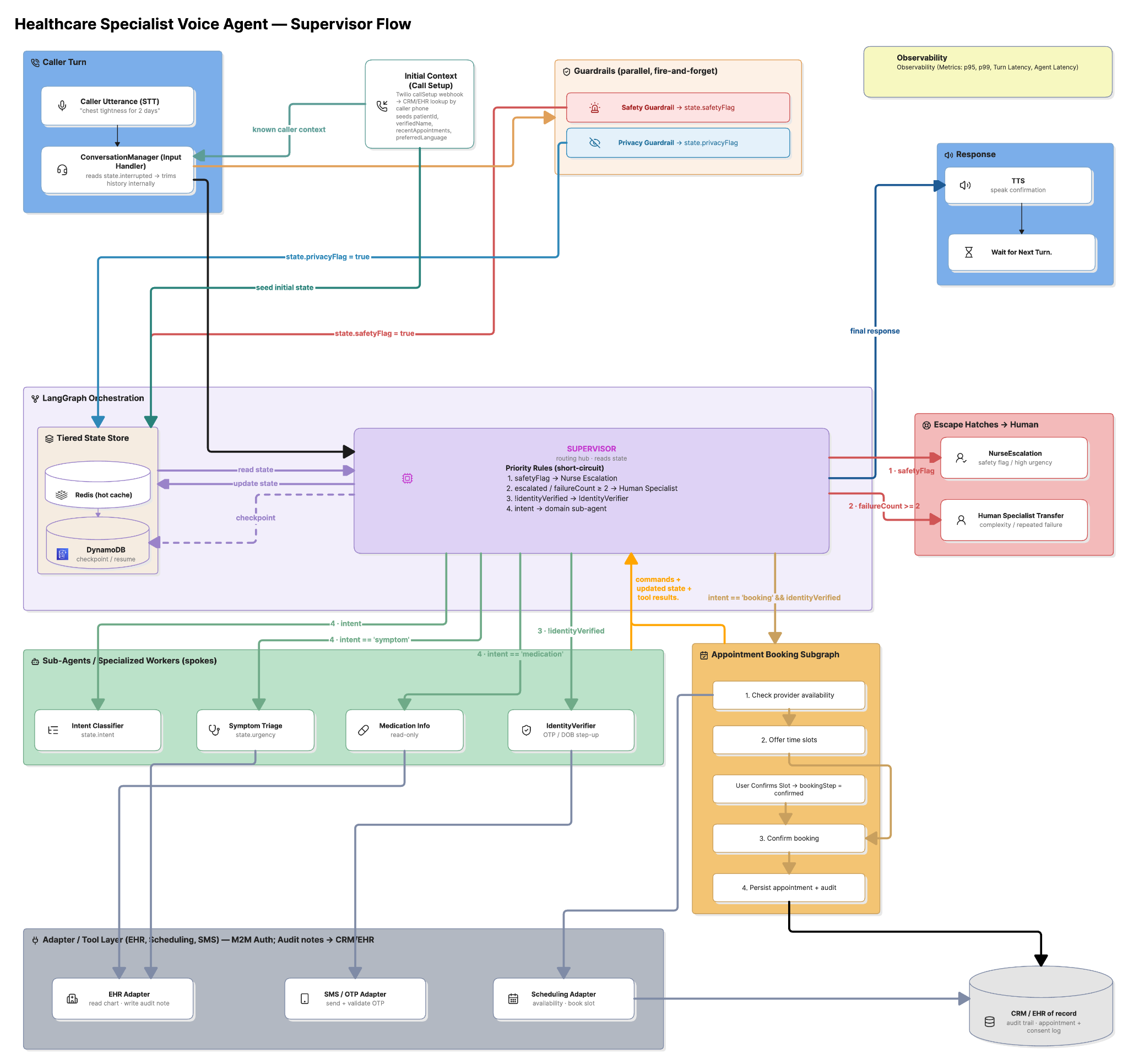
The following technical flow explains how the healthcare voice agent executes each turn with deterministic, graph‑driven control.
1. Caller speaks—audio stream begins
The caller’s voice enters the system.
The Conversation Manager starts a new turn and captures raw audio and session metadata.
2. STT — audio → transcript
Speech‑to‑text converts the audio into a text transcript.
This transcript becomes the input for guardrails and orchestration.
3. Initial context is established
The system enriches the turn with both external metadata (caller profile, language/locale, IVR purpose) and internal state (session history, active workflow, typed state).
This forms the initial state the supervisor evaluates.
4. Parallel guardrails run
Before any agent is invoked, guardrails evaluate the transcript asynchronously:
- Safety classifier (medical emergencies)
- Jailbreak / prompt injection detector
- PII leakage detector
- Toxicity filter
- Adversarial input detector
Guardrails update only the flags implemented in this system (e.g., safetyFlag, adversarialFlag). Additional flags like privacyFlag (identity leakage, HIPAA‑style constraints) can be added depending on domain needs.
5. Supervisor reads typed state—deterministic routing
The supervisor evaluates:
- Safety flags
- Identity verification status
- Failure counts
- Intent
- Active workflow/subgraph
- Domain routing rules
It selects the next agent deterministically, not via LLM inference.
6. Domain agent executes
The supervisor invokes the correct specialist agent:
- Intent classifier
- Symptom triage agent
- Medication information agent
- Identity verification agent
- Appointment booking subgraph (multi‑step workflow)
Each agent:
- updates the in‑memory typed state
- produces a command (e.g., “book appointment” or “verify identity”) that the supervisor uses to decide the next action.
7. Tool layer executes—adapters integrate with backend systems
If the agent requires external data or actions, the tool layer handles it:
- Scheduling adapter → provider availability, appointment creation
- EHR adapter → patient chart lookup, audit notes
- CRM adapter → interaction logging
- SMS/OTP adapter → identity verification, confirmations
All tool calls are structured, validated, and state‑driven.
8. Supervisor regains control — evaluates updated state
After the agent and tools finish, the supervisor rereads the typed state and selects the next agent or terminates the workflow.
9. Checkpointing state persisted
The supervisor persists state after every node.
Persistence includes:
- Redis (hot state)
- DynamoDB (checkpoint/resume)
10. TTS — supervisor triggers speech output
The agent’s output is passed to the response layer. The supervisor triggers TTS, which converts the text into natural speech.
11. Disconnection handling (critical)
If the caller disconnects at any point, including mid‑agent:
- The telephony layer fires a disconnect event
- Supervisor stops routing
- Supervisor marks sessionStatus = disconnected
- Supervisor persists the last valid typed state snapshot
- Agent execution is terminated
- Workflow is safely paused
12. Resume-after-disconnect
When the caller reconnects:
- Supervisor loads the last DynamoDB checkpoint
- Restores typed state
- Resumes the workflow exactly where it left off
Examples:
- Booking resumes at slot confirmation
- Triage resumes at the next question
This is the purpose of checkpoint/resume
13. Wait for the next turn—loop repeats
The system waits for the next caller utterance and repeats the entire pipeline.
Observability runs across the entire workflow — latency, error rates, guardrail triggers, and session analytics are continuously captured to keep the system fully measurable and reliable.
Healthcare Example: Multi‑Agent Orchestration in Action
Below are a couple of examples to demonstrate how it works in action
- Safety Scenario
- Caller says, “chest tightness“—Safety classifier sets safetyFlag = critical.
- Supervisor routes to triage agent – Safety overrides everything.
- Triage agent asks focused questions – Agent updates the state with symptoms, severity, and escalation needs.
- Supervisor sees escalated = “safety” – Routes to human transfer.
- Human nurse takes over – Clean handoff with full context.
- Booking Scenario
- Caller says, “I want to book an appointment.” — Intent classifier sets intent = booking.
- Supervisor checks authFlag = false — routes to authentication agent.
- OTP is verified — typed state updates authFlag = true, patientId resolved.
- Supervisor routes to booking subgraph — agent checks provider availability and updates slotOptions.
- Agent offers time slots — the caller selects one; typed state sets selectedSlot.
- Agent asks for confirmation — caller says “Yes”; typed state sets bookingStep = confirmed.
- Scheduling tool creates an appointment using typed‑state arguments — appointmentId stored.
- Supervisor triggers TTS — caller hears final confirmation with date, time, and booking ID.
- Typed state is checkpointed — workflow can resume cleanly if the caller disconnects or interrupts.
These examples illustrate how deterministic multi‑agent orchestration behaves under real‑world conditions.
Closing Thoughts
Multi‑agent orchestration transforms voice systems from fragile, prompt‑driven chatbots into reliable operational infrastructure. By grounding every turn in deterministic supervisors, strongly typed state, scoped specialist agents, and fast, layered guardrails, voice interfaces behave predictably even under noise, interruptions, and high‑stakes conditions. Workflows stay intact, safety overrides fire instantly, and human escalation becomes clean and contextual.
The trade-off is engineering complexity: more agents, more tools, more evaluation suites, and more state transitions to test. But these costs are far lower than the chaos of debugging a monolithic prompt or recovering from a safety incident. As voice interfaces become core interaction layers for healthcare, finance, and enterprise automation, this kind of rigorous systems engineering isn’t optional—it’s the foundation that makes truly enterprise‑ready voice agents possible.

Leave a Reply